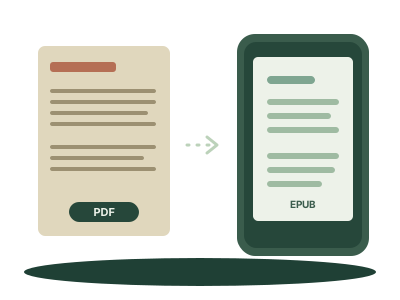
An ebook can be an EPUB or a PDF, but they are not two names for the same thing. The important difference is not how you download it; it is what the text does on a small screen.
A PDF keeps a page exactly as it was designed. An EPUB keeps the book's text and lets the reader lay it out again. That is why a novel usually reads better as an EPUB, while a book full of illustrations, tables or deliberate design often needs to stay a PDF.
A PDF keeps the page
A PDF is made for a page to look the same on a screen, on paper and on a computer. The place of every line, image and page number is fixed.
That is ideal when the page matters: a comic, art book, score, manual with diagrams or something you want to print. It also helps when several people need to see exactly the same page.
On a small Kindle, Kobo or phone, it has a drawback: making the type bigger does not rearrange it. You zoom in, then move sideways to read a long line. The PDF is still the same page, just seen through a magnifying glass.
An EPUB fits the reader
An EPUB holds the book's text, chapters, images and details such as its title and author. The reader decides how to display it for your screen and preferences.
That means an EPUB lets you:
- make the text bigger or smaller;
- change the typeface;
- adjust margins and line spacing;
- read in portrait or landscape;
- keep reading comfortably when you switch between a Kindle, Kobo and phone.
When you change any of those things, the page breaks change too. That is not a mistake: it is what lets a 300-page novel remain comfortable on both a phone and an e-reader.
EPUB and PDF, side by side
| EPUB | ||
|---|---|---|
| Text | Fits the screen | Fixed on a page |
| Type size | You choose it | You can only zoom the page |
| Best for | Novels, essays and continuous text | Comics, magazines, scores, forms and designed pages |
| Printing | Not designed for it | Keeps its design when printed |
| On a small e-reader | Comfortable | May need zooming and side-to-side scrolling |
There are exceptions: fixed-layout EPUBs exist, especially for comics and children's books. But most fiction EPUBs have reflowable text.
Which format suits your book?
Choose EPUB when reading lots of text comfortably is the point. It is the format to look for with a novel, an essay or a text-heavy PDF you want to take to a Kindle or Kobo.
Keep the PDF when each page's composition matters: full-page illustrations, columns, scores, maps or forms. Converting it to EPUB can split an image from its caption or jumble a table.
If you have a single-column text PDF, try Pecia's PDF to EPUB converter. It works in your browser: check the title, author and chapters, then download the EPUB without uploading the file. You can then check it with the EPUB validator.
The format does not say whether you may share it
An EPUB is not always unprotected. An ebook can be an EPUB and carry DRM; another can be DRM-free yet still have a licence that permits personal use only. The format and the permissions are separate things.
To read a file on your own Kobo or send it to your Kindle, look for a DRM-free EPUB and respect the licence under which you got it. To lend or share an ebook, an EPUB file or the absence of DRM is not enough: its rights must allow it.